
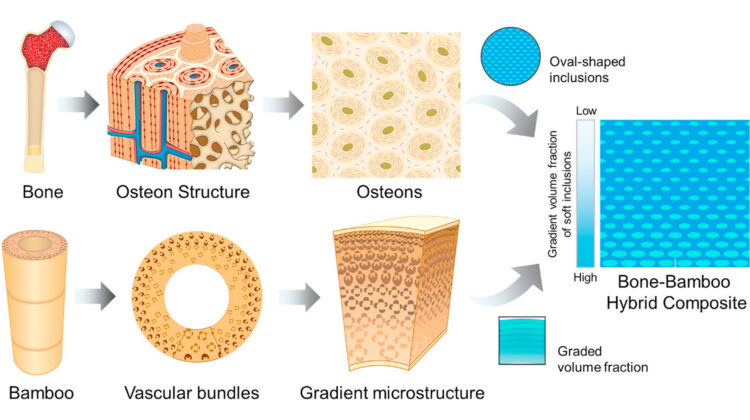
Researchers at National Taiwan University have developed bioinspired composites that mimic bone and bamboo structures to improve strength and toughness simultaneously. Using artificial intelligence, simulations and 3D printing, the team discovered how soft layers near cracks can prevent catastrophic failure.
Nature has spent millions of years developing materials that are both strong and resistant to fracture. Bone, for example, can absorb substantial energy without catastrophic failure, while bamboo uses gradual structural variations to withstand bending and external forces. Inspired by these natural systems, the researchers developed a new class of bioinspired composite materials that combine design principles from both bone and bamboo.
The hybrid composites designed by the research team contain stiff and soft regions arranged in carefully controlled gradients. Using computer simulations, they investigated how the arrangement of these layers influences crack propagation and fracture behaviour. Surprisingly, the researchers found that placing a softer material layer near a crack or notch could actually improve both strength and toughness at the same time.
Normally, soft materials are expected to weaken a structure. However, the study showed that strategically placing compliant layers near stress-concentration regions redistributed stress and delayed crack growth. Instead of propagating directly through the structure, cracks were forced to deflect and propagate along more tortuous paths, allowing the material to absorb more energy before failure.
Advertisement

To accelerate the discovery of improved designs, the team also trained an artificial intelligence model capable of predicting the mechanical behaviour of thousands of possible material configurations. Even though the AI model was trained using only a relatively small dataset, it successfully predicted the strength and toughness trends across a much larger design space.
The researchers then fabricated selected designs using multi-material 3D printing and experimentally confirmed the computational predictions. The printed composites showed improved fracture resistance and energy absorption, validating the effectiveness of the bioinspired gradient design strategy.
The study demonstrates how combining natural design principles with artificial intelligence and additive manufacturing can accelerate the development of next-generation lightweight, damage-resistant structural materials. Potential future applications include protective structures, aerospace materials, robotics and advanced engineering components that require high mechanical reliability.
‘Nature achieves exceptional mechanical performance not through uniformity, but through carefully organised structural variations. Inspired by bone and bamboo, we found that strategically introducing local softness can significantly enhance fracture resistance in structural composites,’ said Shu-Wei Chang, a professor of civil engineering at National Taiwan University.
The research has been published in Composites Part B: Engineering.