
A new study led by researchers at Cornell University has approached the question of whether healthcare robots actually make care easier for the people who give and receive it by inviting healthcare workers, long-term care residents and community members to help design the robots themselves.
The research documents a 14‑week ‘co-design’ project in which nurses, doctors, nursing centre residents, artists, engineers, computer scientists and craftsmen worked side by side to imagine and physically build robots that could ease daily burdens in healthcare settings.
Rather than starting with technical capabilities, the team began by examining what frustrates healthcare workers, what confuses or stresses patients, and where a robot might realistically help.
‘Many healthcare facilities experience challenges managing and caring for patients, yet limited research explores the common issues faced by healthcare workers and patients, and how robot design could help,’ said Angelique Taylor, the Andrew H and Ann R Tisch assistant professor at Cornell Tech and a faculty fellow in the Cornell Institute for Healthy Futures.
Advertisement

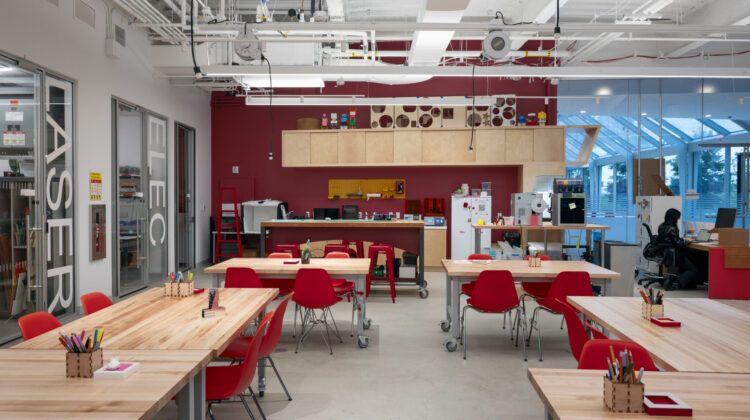
Over three months, 22 participants met weekly in Cornell Tech’s MakerLAB – a hands-on learning environment dedicated to creative exploration, prototyping and collaborative making. The programme also drew on the ethos of CRAFT@Large, a research collective founded at Cornell Tech focused on craft, design and fabrication as pathways for experimentation, learning and community engagement.
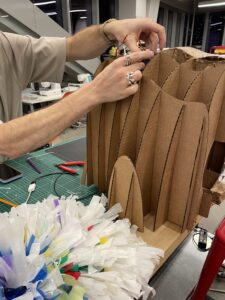
‘Digital fabrication is not just a manufacturing step,’ said Niti Parikh, director of learning spaces and MakerLABs at Cornell Tech and founder of CRAFT@Large. ‘It acts as an instrument of thought. It allows non-technical stakeholders to move from being passive observers to making grounded, expert judgments about complex AI.’
In the MakerLAB, the 22 participants worked to tackle challenges across three healthcare environments: an emergency department, a sleep disorder clinic and a long‑term rehabilitation facility. The teams moved step by step from brainstorming to cardboard mock-ups to full-size, interactive robot prototypes. When teams began constructing full-scale robots, issues such as hallway width, patient comfort, noise, hygiene and safety came into focus – details that rarely surface in interviews or sketches alone.
One emergency department team designed a bear-shaped robot that could deliver medical kits directly to patient rooms before a doctor arrives, saving time for nurses in high-pressure situations. A sleep clinic team built a gentle, concierge-style robot with calming lights to guide patients through unfamiliar nighttime procedures. For the long-term care rehabilitation setting, participants focused on social connection, creating a robot that could provide entertainment, display daily schedules and help residents feel less isolated.
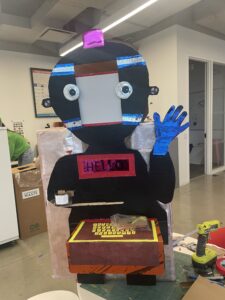
‘We found that robots as embodied AI systems must be attuned to environmental context,’ said Taylor, who is also affiliated with Cornell Bowers and Weill Cornell Medicine. ‘That means understanding the physical constraints of the built environment and patient conditions.’
Advertisement
Across all settings, the researchers found that robots were most valuable when they handled repetitive, non-clinical tasks – freeing humans to focus on care that requires empathy, judgment and personal connection.
Just as important as the designs themselves was where the work happened. Parikh described the MakerLAB as a rare neutral zone – separate from clinical hierarchies and academic pressure – where experimentation felt safe. ‘The MakerLAB acted as a third place,’ she said. ‘This neutrality is necessary to create a space where hierarchies dissolve, and mistakes are encouraged.’
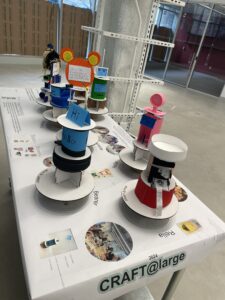
As participants learned how robots move, sense and interact, they also grew more confident contributing ideas – even without technical backgrounds. Artists shaped how robots looked and felt. Long-term care residents flagged moments where machines might feel intrusive. Healthcare workers identified workflows that technology often ignores.
The result, the researchers argue, is a practical framework for designing what they call ‘considerate embodied AI’ – robots that are attentive to social norms, spatial constraints and human needs, not just efficiency. The findings come as hospitals nationwide look to technology to address staffing shortages, burnout and rising patient loads.
‘The physical prototype becomes the common language that connects a nurse’s lived experience with a researcher’s technical goals,’ said Parikh. ‘Our work transformed participants into active co-designers, allowing them to physically externalise their expertise into functional, interactive prototypes.’