
• Skip to main content
  • Skip to secondary menu
  • Skip to primary sidebar
  • Skip to footer
Engineering Designer Magazine

Engineering Designer

  • Home
  • Technology
  • Education
  • Sustainability
  • Materials
  • Medical
  • Construction
  • Advertise
  • iED
You are here: Home / Materials / New alloy design could power solid-state batteries that charge faster and last longer

New alloy design could power solid-state batteries that charge faster and last longer

November 11, 2025 by Geordie Torr

A team co-led by engineers at the University of California San Diego has developed a new design strategy for metal alloy negative electrodes that could significantly improve the performance and durability of next-generation solid-state batteries. The work could help advance the path toward practical, high-performance energy storage for electric vehicles.

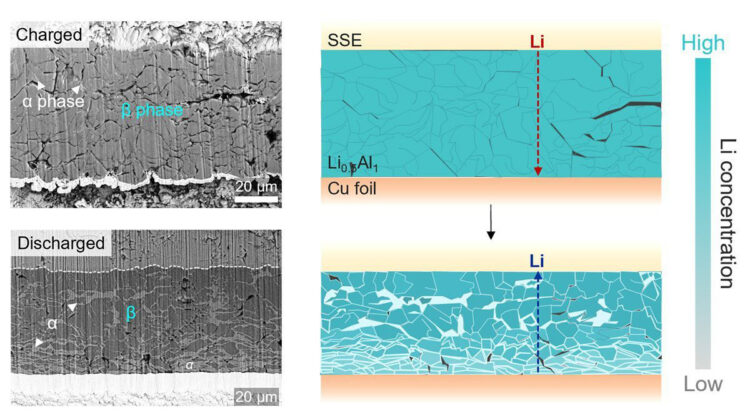
The team focused on negative electrodes made of lithium-aluminium alloy. They studied how lithium ions move through different phases of the material – a lithium-rich ‘beta’ phase and lithium-poor ‘alpha’ phase – and how these phases influence the battery’s performance. By adjusting the ratio of lithium to aluminium, the researchers were able to control the distribution of the alloy’s beta phase.

Advertisement

The researchers found that increasing the proportion of the beta phase significantly enhanced the movement of lithium within the metal alloy – it provided pathways for lithium ions to diffuse up to ten billion times faster than through the alpha phase. The beta phase also led to denser, more stable electrode structures and enhanced channels of lithium diffusion between the electrode and solid electrolyte.

In tests, batteries with beta phase-enriched lithium-aluminium alloy electrodes demonstrated high charge–discharge rates and maintained capacity over 2,000 cycles.

Advertisement

This is the first study to establish a correlation between the distribution of the beta phase and lithium diffusion behaviour in lithium-aluminium alloys, the researchers noted. The findings could guide the design of future alloy-based electrodes with higher energy density, faster charge times and longer lifespans.

The research has been published in Nature Communications.

Filed Under: Materials, Sustainability, Technology

Primary Sidebar

SUBSCRIBE And get a FREE Magazine

Want a FREE magazine each and every month jam-packed with the latest engineering and design news, views and features?

ED Update Magazine

Simply let us know where to send it by entering your name and email below. Immediate access.

Trending

Modern buildings risk not being ready for climate change warns academic

New ultra-low-cost technique could slash the price of soft robotics

Researchers break the mould with new prosthetic design

A ‘ChatGPT for spreadsheets’ helps solve difficult engineering challenges faster

The Engineering Council and the Royal Academy of Engineering relaunch their statement of ethical principles

Using AI to build a machine that draws a heart

Canadian electric vehicle prototypes unveiled

Nominations open for the 2026 Top 50 Women in Engineering Awards

New tool could reduce collision risk for Earth-observation satellites

First CPD course on cryogenic engineering for sustainable flight delivered

Footer

About Engineering Designer

Engineering Designer is the quarterly journal of the Insitution of Engineering Designers.

It is produced by the IED for our Members and for those who have an interest in engineering and product design, as well as CAD users.

Click here to learn more about the IED.

Other Pages

  • Contact us
  • About us
  • Privacy policy
  • Terms
  • Institution of Engineering Designers

Search

Tags

ied

Copyright © 2026 · Site by Syon Media