
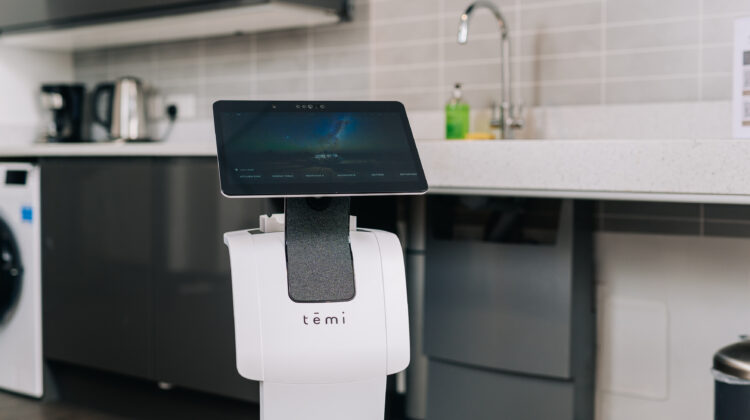
A wheeled robot that can guide patients through routine cardiovascular health checks has been trialled at an NHS GP surgery in Dundee, offering a glimpse of how robotics could take some of the repetitive workload out of primary care.
The system was developed through the HEART-POD project, a collaboration involving Heriot-Watt University’s National Robotarium and Edinburgh Business School, Erskine Medical Practice in NHS Tayside, Tay Health Tech and the Engineering and Physical Sciences Research Council (EPSRC). Rather than developing a medical robot from scratch, engineers adapted a commercially available Temi service robot for the clinical setting.
Equipped with a large touchscreen, the robot can greet patients, direct them to the assessment area and guide them through measurements including height, weight, blood pressure and oxygen saturation. Video demonstrations and verbal instructions explain what patients need to do, while they can communicate with the system through either the touchscreen or voice commands.
The voice element adds another layer to the engineering. Spoken responses are processed using a large language model and automatically coded into the corresponding health data, allowing information normally gathered during the early stages of an appointment to be collected before the patient sees a clinician.
Advertisement

Getting all of that to work reliably in a GP surgery is not simply a matter of putting a chatbot on wheels. The robot has to communicate with several Bluetooth medical devices, recognise speech in a clinical environment and guide patients through the assessment without requiring someone to supervise every step.
After four months of development, the prototype was tested during a two-day Patient and Public Involvement and Engagement workshop at Erskine Practice, Arthurstone Medical Centre, in March 2026. The trial involved 21 people, including 12 patients living with cardiovascular conditions and nine primary care professionals spanning GPs, nurses and administrative staff.
Feedback was broadly positive, with both groups seeing potential for the system to improve clinic efficiency and reduce the amount of staff time spent collecting routine information. Accuracy emerged as the highest priority among participants, followed by ease of use, while the robot’s calm communication and ability to interact using natural language were highlighted as strengths.
The potential workload is considerable. According to the British Heart Foundation, more than 800,000 people in Scotland are living with cardiovascular disease. Annual reviews are an important part of managing patients on cardiovascular disease registers, but the measurements and questionnaires involved also consume time in already stretched primary care services.
For the HEART-POD team, the idea is not to replace the GP. Instead, the robot could handle some of the routine data collection that takes place before a consultation, leaving clinicians with more time to discuss results, treatment and other issues that require their expertise.
Advertisement
The real-world trial also exposed areas where the technology still needs work. Researchers identified microphone performance in clinical surroundings and patients’ differing preferences around privacy as issues that will need to be addressed before wider deployment.
Dr Mauro Dragone, Associate Professor in Human-Robot Interaction at Heriot-Watt University and co-lead of the study, said testing the prototype in a busy GP surgery provided feedback that would be difficult to reproduce in a laboratory. He described the speech recognition and privacy issues as “solvable engineering challenges” that will now inform the next stage of development.
The project also considers whether healthcare robotics makes economic sense. Researchers from Edinburgh Business School are examining the potential costs and benefits alongside technical performance, clinical usefulness and patient experience, an important consideration if systems such as HEART-POD are eventually to move beyond trials and into routine NHS use.
Dr Ronnie Smith, Senior Robotics Engineer at the National Robotarium, said creating a mobile robot capable of connecting reliably to multiple medical devices, processing natural language and autonomously guiding patients through an assessment was a substantial engineering challenge. Reaching a working prototype that could be field-tested in a GP surgery after four months of development, he said, showed how quickly robotics could move into real healthcare environments when engineers and clinicians work together.
The findings will now feed into further development of the HEART-POD prototype, with the team exploring how the technology could be refined for practical use within NHS primary care. The Dundee trial remains an early test, but it suggests that some of the more routine parts of a health check could eventually be handed to machines, giving healthcare professionals more time for the parts that cannot.