
A crack can begin deep inside a component, out of sight long before the damage becomes obvious. Now, engineers at the universities of Glasgow and Sydney have borrowed a medical imaging technique to watch cracks develop inside 3D-printed materials, potentially giving future components a way to warn of approaching failure.
The team printed plastic containing carbon nanotubes into intricate lattices of struts and open spaces. Such structures can be tailored for low weight, strength, flexibility or impact resistance. The nanotubes add another useful property: they allow electricity to flow through the material.
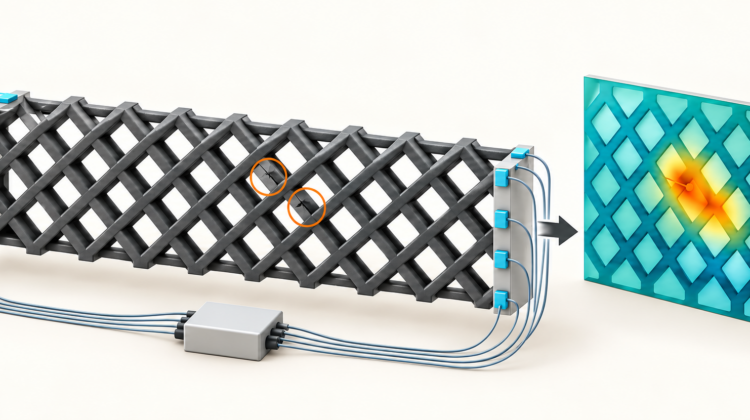
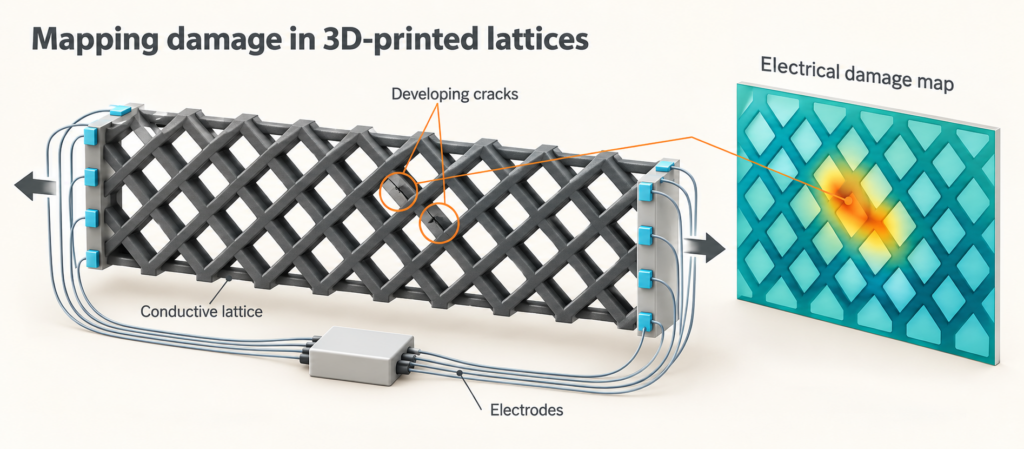
To see what happens inside the lattice, the researchers turned to electrical impedance tomography (EIT), a technique used in hospitals to monitor lung function. Electrodes pass current through the structure and measure voltage differences at its surface. As the material stretches and cracks form, its conductive pathways change, leaving an electrical signature of the damage.
A computer algorithm turns those measurements into maps showing where damage is developing and how it spreads. Unlike measurements taken at individual points, the approach gives a picture across the structure, including regions away from the electrodes.
Advertisement

The researchers put rectangular lattices measuring 48 millimetres across under tension until they broke. Their maps located damage to within approximately one strut of its actual position, with direct observations confirming where the specimens eventually failed. When the team deliberately introduced tiny cracks into some struts, the system tracked them as they spread under increasing strain.
‘Our research shows that, by combining carefully designed lattice structures with EIT, we can obtain this much richer picture of structural behaviour, including detecting damage before the structure ultimately fails,’ said Professor Shanmugam Kumar, of Glasgow’s James Watt School of Engineering.
The approach could eventually help monitor aircraft parts, vehicle components or medical implants as they experience strain and wear. For now, the work remains a laboratory demonstration, with further development needed to scale it for practical use.
The research is published in Advanced Functional Materials.