
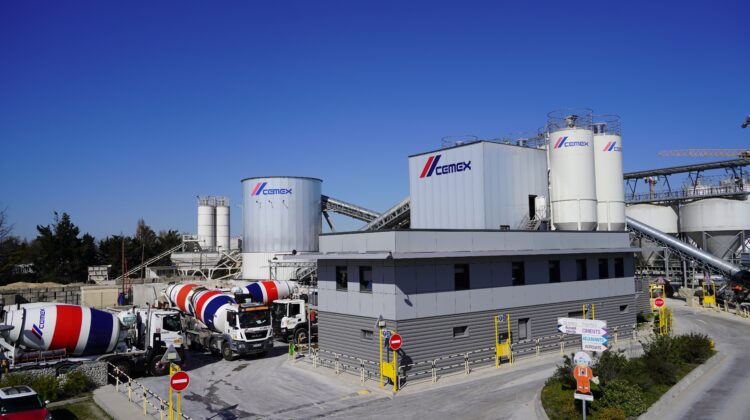
The heat needed to make cement has to come from somewhere. For much of the industry, that means burning fossil fuels to reach the temperatures production demands. A new European project involving Imperial College London is investigating whether ammonia and hydrogen could do the job instead—and whether making the switch would deliver the environmental benefits promised.
Called HARMONI, the project brings together 12 partners with almost €8 million in European Union funding. Part of its proposed fuel supply would come from an unlikely source: wastewater.
Ammonia contains no carbon, making it an attractive candidate for replacing carbon-based fuels. There is already an established network for storing and transporting it, and it can be produced using renewable energy. Burning it, however, is less straightforward. It is difficult to ignite, its flames travel slowly and it can release nitrogen oxides, which are harmful air pollutants.
The project’s approach is to recover ammonia from wastewater at cement plants or nearby treatment facilities, supplement it with externally supplied green ammonia and split some into hydrogen on site. This process, known as ‘cracking’, produces hydrogen that helps the fuel mixture burn more effectively.
Advertisement

The system would also adjust its fuel mix as renewable electricity supplies rise and fall, allowing a plant to make use of surplus wind and solar power when it is available.
Before any of this can be assessed as a complete system, the individual technologies need testing. Partners will begin with laboratory experiments and small-scale systems, then bring the results together in a digital twin—a virtual representation of a CEMEX cement plant in Alicante, Spain.
Imperial’s role is to examine what happens across the production process. Led by Professor Evina Katsou, the team will track energy and water use from raw materials to the factory gate, looking for benefits, additional demands and consequences that might otherwise be overlooked.
‘A fix that only moves the problem somewhere else is not good enough,’ Katsou said. ‘In HARMONI, our job is to check, across the whole life cycle, whether this approach really cuts emissions without creating new problems, using trialled scientific methods and data-driven evidence.’
That assessment extends beyond fuel performance. Working with project coordinator SINTEF, researchers will investigate costs, worker safety and employment implications, alongside practical questions such as approvals for changing fuels and connecting to the electricity grid.
Advertisement
The team will also help develop the digital twin’s operator interface and an interactive tool that other cement producers can use to explore the approach before investing. Training will be developed with plant managers, operators and technology specialists.
By August 2029, the partners aim to establish whether the system offers a workable route towards lower-impact cement production. For plant operators, the useful answer will be how it performs as a whole: fuel supply, heat, emissions, costs and the everyday business of keeping production running.