
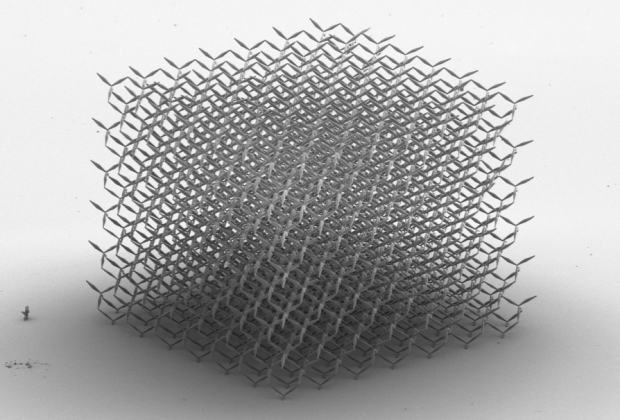
Changing what a material can do usually means changing what goes into it. Metamaterials offer another route: engineer the structure, and it becomes possible to control its behaviour in useful ways. Potential applications range from managing heat to putting augmented-reality images into a pair of glasses.
A new national roadmap sets out how the UK could turn more of that research into commercially useful products. Supported by researchers at the University of Sheffield, it identifies the manufacturing capabilities, partnerships and investment needed to move metamaterials beyond the laboratory.
The distinction is in how these materials work. Their useful properties come from deliberately engineered structures, rather than chemical composition alone. That gives designers another way to influence how a material interacts with its surroundings, opening up possibilities in aerospace, communications, energy and healthcare.
In optics, for example, metamaterials could be incorporated into ordinary glasses to allow the wearer to see augmented-reality images. These might display safety information or provide assistance with a task. Other potential applications include managing extreme temperatures, recovering heat, improving solar-energy technologies and transferring power wirelessly.
Advertisement

The challenge is getting promising research into a form that industry can manufacture and use. A material may demonstrate an impressive property in an experiment, but turning that result into a dependable component requires a way to produce it consistently and integrate it into a working system.
Published by the Metamaterials Strategy Action Group, which was convened by the UK government, the roadmap calls for a coordinated approach to those challenges. Its aim is to accelerate commercialisation and industrial adoption over the next decade while continuing to support fundamental research.
The UK Metamaterials Network will help connect that research with manufacturing expertise and potential users. For engineers, those connections matter because the requirements of a finished product need to inform how a material is developed, produced and tested.
Dr Simon Pope, a lecturer in Sheffield’s School of Electrical and Electronic Engineering, leads the network’s Space and Aviation Challenge. His role forms part of the wider effort to bring universities and industry together, supporting research while developing a manufacturing base capable of turning advances into products.
The roadmap’s emphasis is on building the capabilities needed to make those applications practical. That includes scaling up production, strengthening supply chains and helping researchers and businesses work together.
Advertisement
For a technology whose possibilities depend on carefully designed structures, making the material is only part of the engineering task. The next step is making it reliably, at a useful scale, for a product that needs it.