
Tungsten carbide is one of those materials engineers love, and manufacturers often curse. It’s incredibly hard, remarkably wear-resistant, and capable of surviving conditions that would quickly destroy most metals. The downside? It’s also notoriously difficult to manufacture.
Researchers have now demonstrated a new form of industrial 3D printing that could make producing tungsten carbide components more efficient while using far less of the expensive raw materials they require. Instead of shaping large blocks of material and machining away the excess, their approach builds components only where material is needed, reducing waste without sacrificing the hardness that makes tungsten carbide so valuable.
The research, published in the International Journal of Refractory Metals and Hard Materials, focused on tungsten carbide-cobalt (WC-Co), a cemented carbide used in everything from cutting tools and drill bits to mining equipment and industrial tooling. Wherever extreme wear is a problem, chances are there’s a piece of WC-Co doing the hard work.
Producing those components isn’t cheap. Conventional manufacturing relies on powder metallurgy, where fine tungsten carbide and cobalt powders are compressed under high pressure before being sintered at elevated temperatures. It works well, but it also consumes two expensive raw materials and often uses considerably more material than ends up in the finished part.
Advertisement

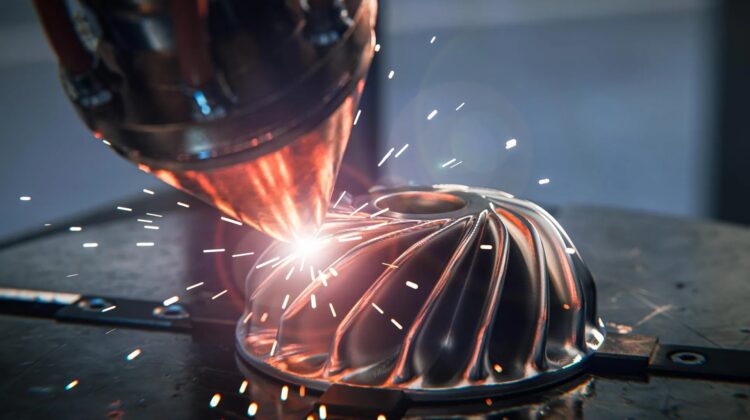
That’s where additive manufacturing begins to look attractive. Rather than removing material, the researchers deposited it layer by layer using a process called hot-wire laser deposition. A laser provides the heat, while a preheated filler wire delivers the material. Because the wire is already hot before it reaches the workpiece, less energy is needed from the laser and material can be deposited more efficiently.
Simple enough in theory, but the tricky part is the temperature. Fully melting tungsten carbide changes its microstructure, reducing the very hardness engineers are trying to preserve. Instead, the team softened the material just enough for it to bond during deposition without completely melting the carbide particles. It’s a subtle difference, but an important one.
The researchers tested two different manufacturing arrangements. One produced localised decomposition of the tungsten carbide near the top of the build. The other avoided many of those defects but initially struggled to achieve the required hardness. By introducing a nickel alloy interlayer and carefully controlling the processing temperature, they eventually produced defect-free material with a hardness exceeding 1,400 HV, comparable to conventionally manufactured cemented carbide.
There’s still work to do. The process needs to be refined to reduce cracking, improve durability and manufacture more complex geometries before it becomes a practical production technique.
Even so, the study points towards an interesting shift in how extremely hard materials could be manufactured. Rather than carving away expensive tungsten carbide until only the finished component remains, future production methods may place it exactly where it’s needed—and nowhere else. For a material that’s both strategically important and increasingly costly, that’s not just good engineering. It makes a great deal of economic sense too.