
Soil might look fairly inert, but beneath the surface it is constantly responding to water, temperature, nutrients and biological activity. Now Cambridge researchers are exploring a more unusual possibility: that soil itself could be treated as a kind of natural computer.
Researchers at the University of Cambridge’s Bio-Inspired Robotics Laboratory are investigating soil as an ‘embodied’ information processor – a physical system capable of sensing and responding to changes in its environment without anything resembling a conventional brain.
The work could ultimately inspire new approaches to low-energy computing, environmental monitoring and precision agriculture, where some of the sensing and information processing is effectively embedded in the material being monitored.
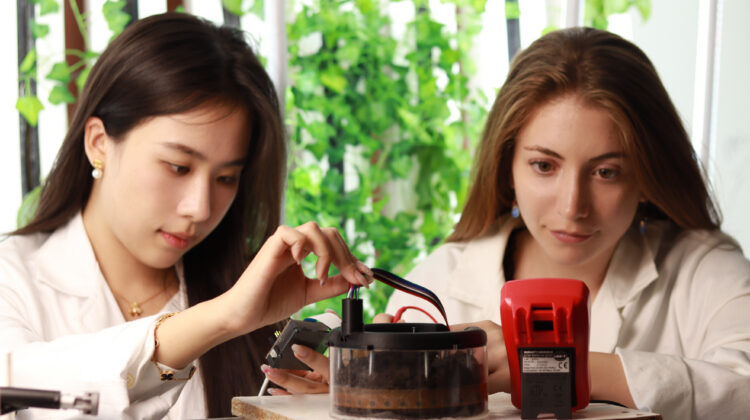
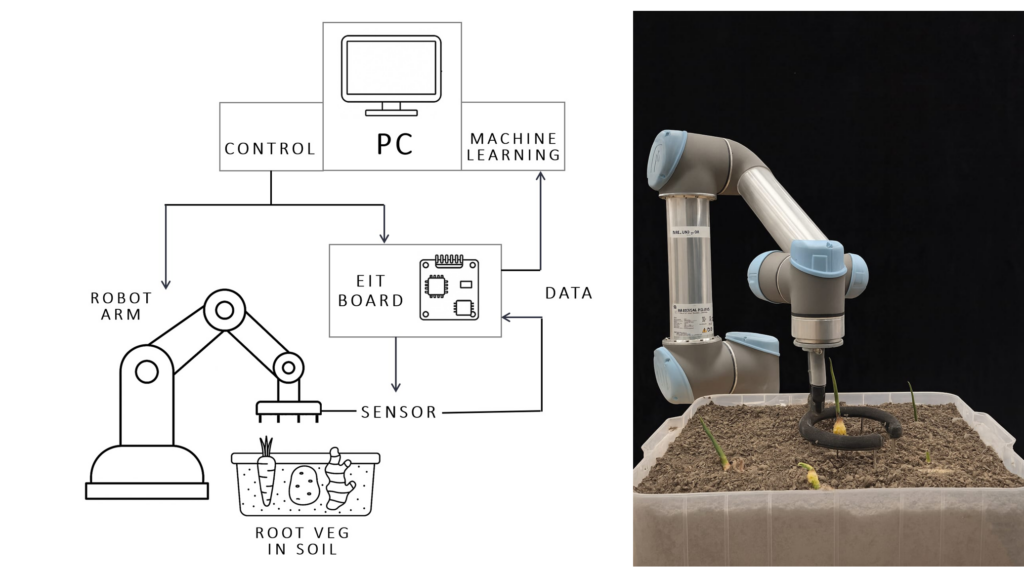
At the centre of the research is electrical impedance tomography (EIT), a technique that measures differences in the electrical conductivity and impedance of a material. PhD students Catherine Merchant and Xiaoxian ‘Amanda’ Xu have been using EIT to peer inside soil without relying on cameras or other vision-based systems.
Advertisement

Their first published work used the technique to distinguish between different types of soil according to grain size, while also measuring moisture. The researchers believe the resulting system is the first non-vision-based sensor capable of classifying both soil type and moisture level.
That distinction matters because water itself changes soil’s electrical properties. By measuring moisture alongside the electrical response, the researchers can begin to separate changes caused by water content from those arising from the physical structure of the soil.
But it is what those electrical properties might enable next that makes the research particularly interesting.
‘Soil has inherently rich, nonlinear and dynamic electrical properties,’ said Merchant. ‘This means soil could act not only as a sensing medium but also as a form of natural analogue processor.’
In other words, rather than placing a conventional sensor into the ground and asking it to measure the soil, future systems could potentially make use of the soil’s own physical response to environmental changes.
Advertisement
The researchers suggest this could provide an early warning of drought, contamination or deteriorating soil health before obvious changes appear at the surface. In agriculture, similar techniques could provide real-time information about moisture, pH and nutrient conditions, helping farmers respond more precisely to what is happening underground.
There are parallels with another area of bio-inspired engineering known as embodied computation. Instead of asking a powerful processor to control every aspect of a robot, engineers can design the machine’s materials and physical structure to perform some of that work themselves.
Soil offers an intriguing natural version of the same principle. Its grains, pores, moisture, microbes and fungi form a constantly changing physical network that stores, filters and responds to information from its surroundings.
For the Cambridge team, understanding that behaviour could lead to technology that does more than simply monitor the ground beneath us. It could allow the ground itself to become part of the sensing – and perhaps even the computing – system.