
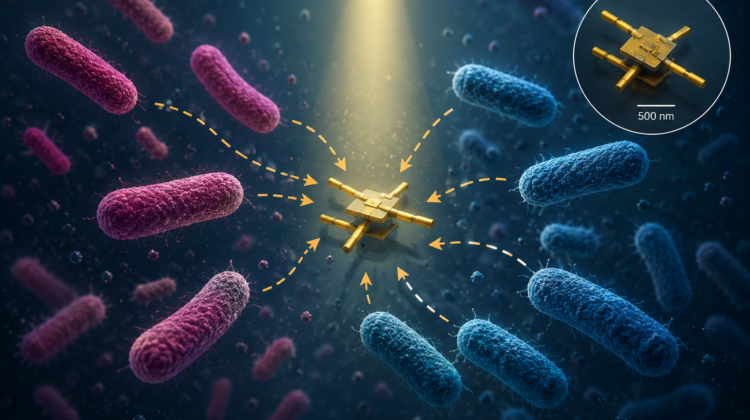
Working with individual bacteria presents an obvious engineering problem: the tools used to manipulate them need to operate on roughly the same scale. Researchers at Julius-Maximilians-Universität Würzburg (JMU) have now developed light-powered nanorobots small enough to move through this microbial world and physically interact with the bacteria around them.
The devices measure less than one micrometre across, making them around 50 times smaller than the diameter of a human hair. Despite their size, they can be propelled and steered through liquid, collect bacteria and carry them to another location before releasing them.
The work builds on earlier research from a team led by Professor Bert Hecht, which developed microscopic devices known as microdrones. Instead of using motors, batteries or conventional mechanical propulsion, the tiny machines exploit something rather more fundamental: the momentum carried by light.
Their propulsion system uses plasmonic nanoantennas that interact with incoming light. The antennas absorb light with particular properties and redirect it in a chosen direction. Every redirected photon produces an extremely small recoil force. On an everyday scale, that force would be insignificant, but when the object being pushed is smaller than a bacterium, it is enough to produce useful movement.
Advertisement

Shrinking the robots below one micrometre meant simplifying how that movement is controlled. The team achieved this using nanoscale antenna wires that naturally align themselves with the polarisation of incoming light. Changing that polarisation changes the direction the nanorobot faces, while photon recoil provides its forward propulsion.
The result is effectively a remotely controlled microscopic vehicle, albeit one without wheels, propellers or an onboard power source.
The nanorobots are also surprisingly nimble. They can perform rapid 90° turns, allowing them to scan different areas of a sample in a controlled pattern rather than simply drifting through the liquid.
More importantly, the team demonstrated that the robots can interact with biological material as they move. When illuminated, a nanorobot creates a temperature gradient in the surrounding liquid. This generates a thermophoretic attraction that draws nearby bacteria towards it, allowing groups of bacterial cells to gather around the moving robot.
Once collected, those bacteria can be transported elsewhere and released at a chosen location. The nanorobots remain manoeuvrable while carrying larger groups, although the additional load reduces their speed.
Advertisement
Lead experimental scientist Jin Qin described the devices as being almost like “microscopic cleaning devices”, capable of tracking down and collecting bacteria. Under controlled laboratory conditions, the team demonstrated that they could effectively clear bacteria from one microscopic area and deposit them elsewhere.
That ability opens up possibilities beyond simply moving bacteria around a laboratory sample. Tools capable of manipulating individual cells or groups of microorganisms could eventually prove useful in microbiology and biomedical research, where scientists often need to isolate, organise or study biological material at scales inaccessible to conventional equipment.
There is still a considerable distance between a laboratory demonstration and nanorobots performing useful tasks in complex biological environments. Controlling microscopic machines in carefully prepared samples is one thing; doing so reliably among the enormous variety of cells, molecules and fluids found in living systems is another.
Still, the experiment demonstrates an unusual form of engineering control at a remarkably small scale. Light has long given scientists a way to observe the microbial world. With machines small enough to operate inside it, the same light can now be used to move things around.
Research published in: Science Robotics