
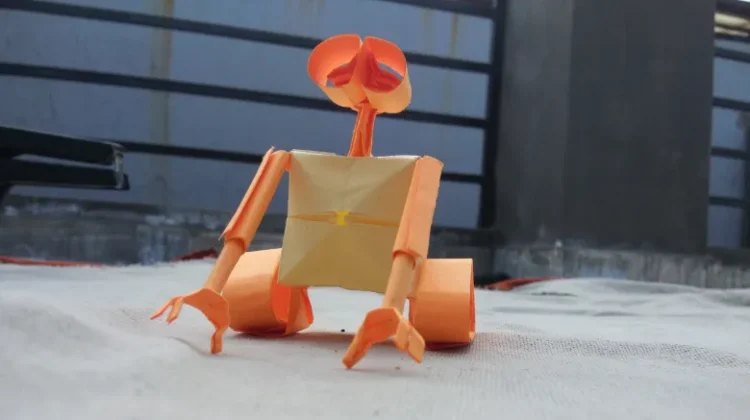
Most robots are designed to do one job well. A wheeled robot can move quickly across smooth ground, while a four-legged machine is better suited to uneven terrain. The problem is that once a robot is built, its shape is largely fixed.
Researchers at King’s College London believe that could eventually change.
Working with collaborators in China, the team has completed what it describes as the first systematic study of the geometry behind the flexagon – an origami-inspired structure capable of repeatedly changing shape. The work has led to a new mechanical linkage that could allow future robots to transform continuously between different configurations without becoming mechanically jammed.
Rather than relying solely on increasingly sophisticated software, the researchers argue that future robots should also possess what they call structural intelligence. In other words, part of a robot’s ability to solve problems should come from its physical design as well as its control algorithms.
Advertisement

That idea takes inspiration from nature. Animals adapt their movement to suit their surroundings, whether climbing, swimming or walking across rough ground. A robot capable of changing its own structure could, in principle, adopt similar strategies by reconfiguring itself as conditions change.
The research builds on Origaker, a metamorphic robot previously developed at King’s that demonstrated how origami-inspired mechanisms could allow a machine to alter its form while moving across different types of terrain. The latest work provides the mathematical foundation needed to extend that concept much further.
At the centre of the research is the flexagon, a folded geometric structure first explored as a mathematical curiosity. Although engineers have long been interested in origami-inspired mechanisms for applications ranging from deployable spacecraft to compact packaging, translating paper folding into practical engineering systems has proved difficult. Unlike paper, metals, ceramics and other structural materials cannot simply be folded repeatedly without creating mechanical constraints or fatigue.
To overcome that problem, the researchers developed what they describe as a dual-chiral flexagon linkage. By connecting multiple flexagons into a ring and applying principles from geometric kinematics and screw algebra, they created a mechanism capable of repeatedly inverting its structure while avoiding the mechanical interference that normally limits reconfigurable systems.
According to the team, that could make continuous shape change possible within a single mechanical structure, something they believe has not previously been achieved.
Advertisement
The concept extends well beyond robotics. Reconfigurable mechanisms based on the same principles could one day be used in deployable space structures, adaptive solar panels or products that physically alter their shape to perform different functions. The researchers even suggest future furniture capable of transforming between entirely different forms.
The work also reflects a broader shift in robotics. As artificial intelligence becomes increasingly capable of controlling machines, researchers are paying greater attention to the mechanical systems those algorithms control. In many situations, a well-designed mechanism can simplify movement, reduce energy consumption and allow a robot to adapt without relying entirely on software.
The researchers hope the new mathematical framework will provide a foundation for future work in modular and soft robotics, where machines increasingly need to adapt to unpredictable environments. While practical shape-shifting robots remain some way off, the study suggests that future advances may depend as much on mechanical design as artificial intelligence.