

Inspired by a deep-sea sponge, engineers at RMIT University in Melbourne have developed a new material with remarkable compressive strength and stiffness that could improve architectural and product designs.
The double lattice design was inspired by the intricate skeleton of a deep-sea sponge, known as Venus’ flower basket, that lives in the Pacific Ocean. Post-doctoral researcher Jiaming Ma (pictured above, at right) said extensive testing and optimisation revealed the pattern’s impressive combination of stiffness and strength, mixed with an ability to contract when compressed.
It’s this last aspect – known as auxetic behaviour – that opens a whole range of possibilities to apply the design across structural engineering and other applications. ‘While most materials get thinner when stretched or fatter when squashed, like rubber, auxetics do the opposite,’ Ma said. ‘Auxetics can absorb and distribute impact energy effectively, making them extremely useful.’
Natural auxetic materials include tendons and cat skin, while synthetic ones are used to make heart and vascular stents that expand and contract as required. But while auxetic materials have useful properties, their low stiffness and limited energy absorption capacity limits their applications. The team’s nature-inspired double lattice design is significant because it overcomes these main drawbacks.
Advertisement

‘Each lattice on its own has traditional deformation behaviour, but if you combine them as nature does in the deep-sea sponge, then it regulates itself and holds its form and outperforms similar materials by quite a significant margin,’ said Ma.
The team’s investigations revealed that with the same amount of material usage, the lattice (pictured below, at left) is 13 times stiffer than existing auxetic materials, which are based on re-entrant honeycomb designs (pictured below, at right) . It can also absorb ten per cent more energy while maintaining its auxetic behaviour, with a 60 per cent greater strain range compared to existing designs.
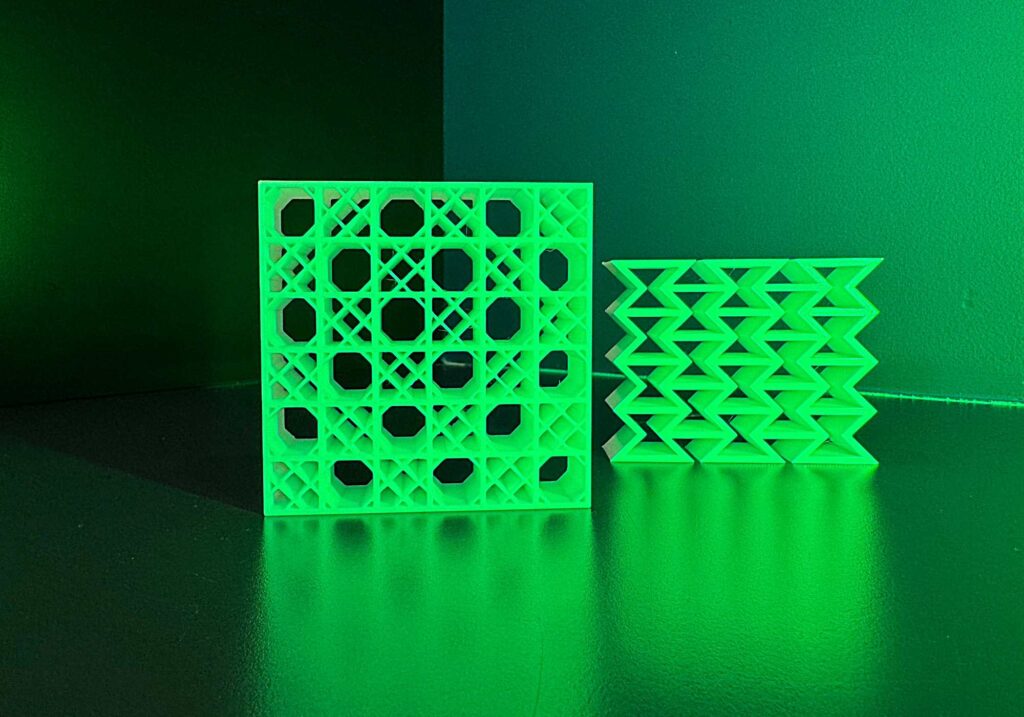
According to Ngoc San Ha, a lecturer in civil and infrastructure engineering, the unique combination of these properties opened several exciting applications for their new material. ‘This bioinspired auxetic lattice provides the most solid foundation yet for us to develop next-generation sustainable building,’ he said. ‘Our auxetic metamaterial with high stiffness and energy absorption could offer significant benefits across multiple sectors, from construction materials to protective equipment and sports gear or medical applications.’
The bioinspired lattice structure could work as a steel building frame, for example, allowing less steel and concrete to be used to achieve similar results as a traditional frame. The structure could also form the basis of lightweight sports protective equipment, bulletproof vests or medical implants.
Honorary Professor Mike Xie (pictured top, at left) said the project highlighted the value in taking inspiration from nature. ‘Not only does biomimicry create beautiful and elegant designs like this one, but it also creates smart designs that have been optimised through millions of years of evolution that we can learn from,’ he said.
Advertisement
The team at RMIT’s Centre for Innovative Structures and Materials has tested the design using computer simulations and lab testing on a 3D printed sample made from thermoplastic polyurethane. They now plan to produce steel versions of the design to use along with concrete and rammed-earth structures – a construction technique using compacted natural raw materials.
‘While this design could have promising applications in sports equipment, PPE and medical applications, our main focus is on the building and construction aspect,’ Ma said. ‘We’re developing a more sustainable building material by using our design’s unique combination of outstanding auxeticity, stiffness and energy absorption to reduce steel and cement usage in construction. Its auxetic and energy-absorbing features could also help dampen vibrations during earthquakes.’
The team is also planning to integrate this design with machine learning algorithms for further optimisation and to create programmable materials.
The research has been published in Composite Structures.