
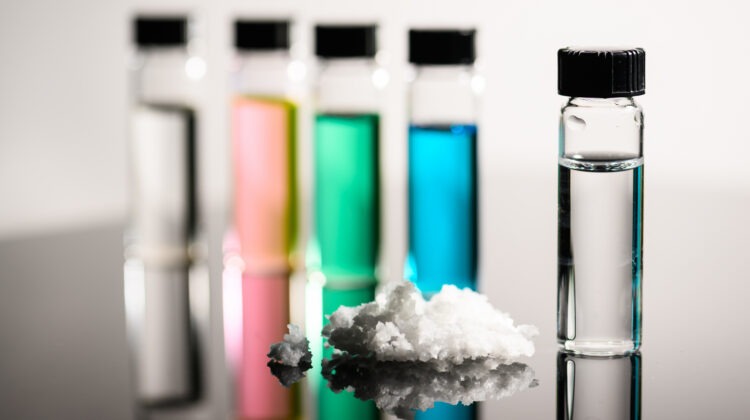
Researchers at the University of Rochester have developed a solar-powered desalination system that produces fresh water while recovering almost all of the dissolved salts as solids rather than generating concentrated liquid brine. The technology uses laser-treated black metal to absorb solar energy and move seawater across its surface, where it evaporates.
The researchers say the approach could address one of desalination’s major environmental challenges while potentially enabling valuable materials such as lithium to be recovered from the remaining salts.
Conventional desalination technologies typically use reverse osmosis or thermal distillation to separate salt from seawater. While effective, these processes can require significant amounts of energy and produce concentrated brine that must be managed or discharged back into the environment.
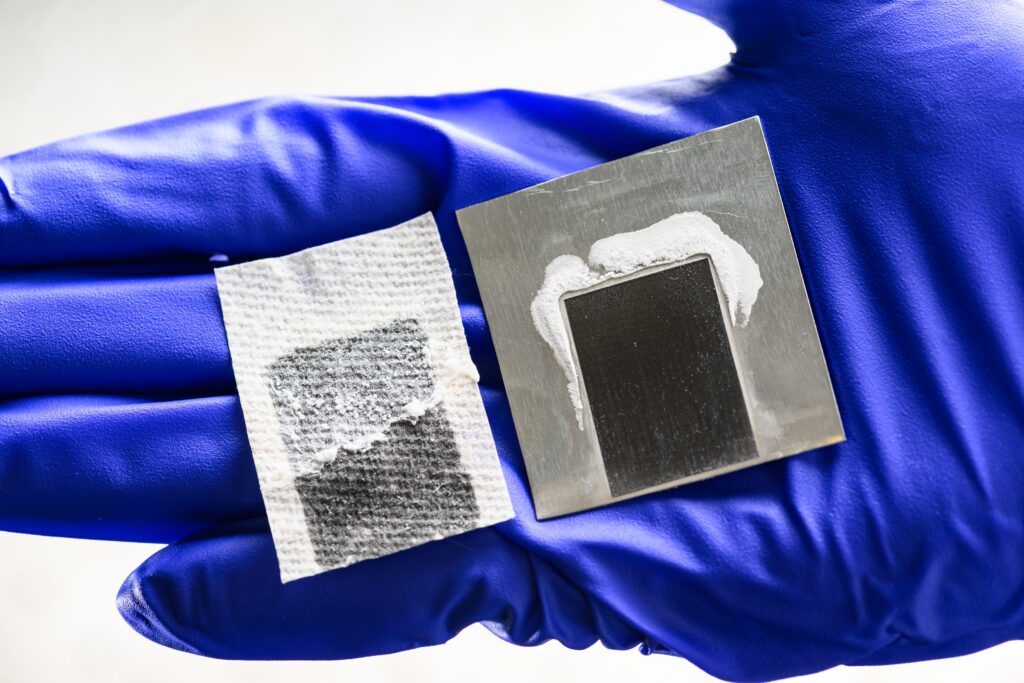
The Rochester system instead uses metal panels treated with femtosecond laser pulses to create microscopic structures across their surfaces. This treatment makes the metal highly effective at absorbing sunlight while also giving it ‘superwicking’ properties, causing water to spread rapidly across the surface rather than forming droplets.
Advertisement

A thin layer of seawater is drawn over an active region of the panel, where absorbed solar energy heats the water and drives evaporation. But as the water disappears, salts and other dissolved minerals remain behind. Left unchecked, these deposits can build up and eventually prevent solar desalination systems from operating effectively.
To overcome this, the researchers engineered microscopic grooves that direct salts away from the active evaporation area towards untreated regions at the sides of the panel. The system also exploits the ‘coffee ring effect’ – the same process that causes particles in a drop of coffee to migrate towards its outer edge as the liquid dries.
‘If you drop coffee on a surface, eventually the water evaporates and there’s a ring left at the outer edge that is the concentrated coffee particles,’ said Professor Chunlei Guo, who led the research. ‘We use that same principle to advance the salts to the passive region.’
Tests using real seawater collected from the Pacific, Atlantic and Indian Oceans showed that the surface could effectively clean itself while continuing to produce fresh water. According to the researchers, nearly 100% of the dissolved salts can ultimately be extracted in solid form rather than remaining as liquid brine.
The team is also investigating whether the resulting mineral mixture could become a useful resource. In separate experiments using water from the Great Salt Lake, researchers incorporated hydrogen titanate nanoparticles into the laser-produced grooves to selectively capture lithium, recovering around 50% of the lithium contained in the salts.
Advertisement
The technology remains at proof-of-concept scale, but the researchers believe its panel-based design could eventually be scaled up. If successfully developed, the approach could allow future desalination systems to produce fresh water while simultaneously reducing brine waste and recovering useful materials from saltwater.
The research is published in Light: Science & Applications.