
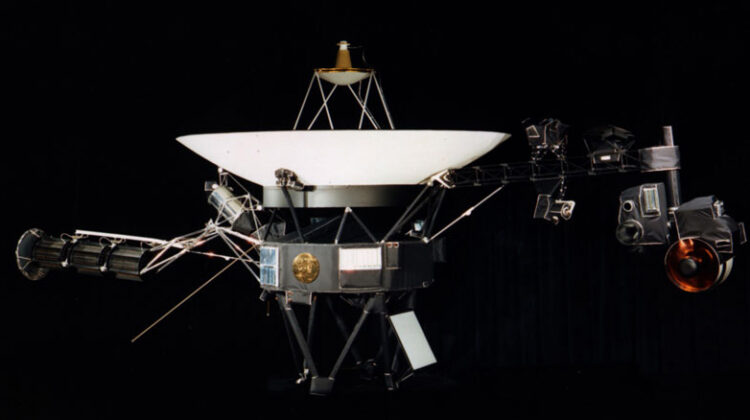
Voyager 2 has survived almost 50 years in space, travelled beyond the planets and crossed into interstellar space. Yet one of the biggest engineering challenges facing the spacecraft today is surprisingly small: finding a few more watts of electricity.
The spacecraft has no solar panels to fall back on. Instead, Voyager 2 and its twin Voyager 1 are powered by radioisotope thermoelectric generators, or RTGs, which turn heat from the radioactive decay of plutonium into electricity. It is a remarkably dependable system, but not an endless one. As the plutonium decays, each spacecraft loses around four watts of available power every year.
After nearly half a century, those four watts matter. Engineers at NASA’s Jet Propulsion Laboratory (JPL) have gradually switched off equipment that is no longer essential, carefully balancing the power needed for science against that required simply to keep the spacecraft alive. Both Voyagers originally carried ten science instruments, although several were retired after their planetary encounters. Since 2024, falling power levels have forced another two science instruments to be switched off on each spacecraft.
Now engineers have found another way to stretch what remains. In an operation nicknamed the ‘Big Bang’, the Voyager team simultaneously shut down certain powered components and switched to alternatives that consume less electricity. It sounds simple enough, but saving power on a spacecraft this old is a balancing act. Components still need to remain warm enough to function, and every change has to be made remotely to a machine launched in 1977.
Advertisement

The savings should keep Voyager 2’s three remaining science instruments operating for at least another year. Without the changes, NASA expected to switch off another instrument before the end of 2026. The team plans to carry out the same power-saving operation on the more distant Voyager 1 in the coming months.
There is no engineering fix for the gradual decline of the spacecraft’s power source, so eventually more systems will fall silent. For now, the Voyager team continues to work with what it has, finding small savings in a spacecraft designed long before anyone knew it would still be operating in the 2020s.
After almost 50 years and billions of kilometres, extending one of engineering’s longest-running missions no longer depends on making more power. It depends on making every watt count.