
Measuring electrical current can tell researchers how a solar water-splitting material is performing, but it may not tell the whole story. A team at Imperial College London has developed a technique that measures oxygen production in real time, revealing that some of the charge passing through a material can be consumed by competing reactions.
The finding could help researchers assess materials more accurately for solar fuel and green hydrogen technologies. It emerged from experiments with hematite, an iron oxide widely studied for its potential to use sunlight to drive water splitting.
The study was led by Dr Flurin Eisner, formerly a research fellow in Imperial’s Department of Materials and now at Queen Mary University of London, together with Dr Daniele Benetti from Imperial’s Department of Chemistry. Professors Ifan Stephens and James Durrant also collaborated on the research.
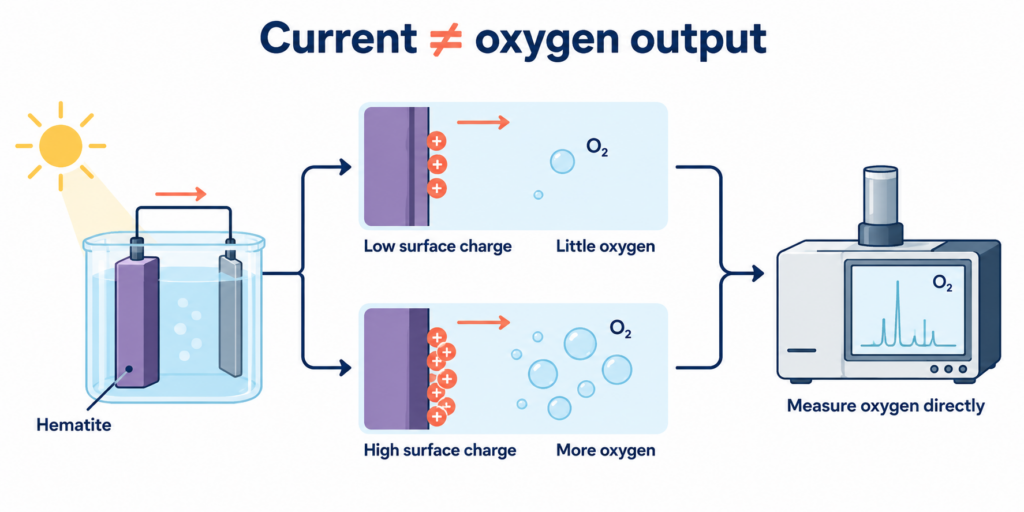
The team identified what it described as a ‘selectivity switch’. At low current levels, much of the electrical charge was diverted into surface reactions rather than producing oxygen. Once sufficient positive charge accumulated at the material’s surface, oxygen production became more efficient, reaching around 80 per cent.
Advertisement

The same behaviour occurred when the reaction was driven electrically in the dark. This suggests that the effect is a property of hematite itself, rather than something that occurs only under illumination. It also challenges the assumption that measuring current provides a reliable indication of how much oxygen a material is generating.
To observe the difference, the researchers developed a custom photoelectrochemical mass spectrometry platform at the Royce at Imperial facility in White City. Supported by the Royce Small Equipment Fund, they adapted an existing electrochemical mass spectrometry system to work with a light-compatible cell.
The resulting instrument allowed them to illuminate a sample, measure its photocurrent and monitor oxygen generation simultaneously. Comparing the measurements exposed losses that would have remained hidden if the team had relied on electrical current alone.
‘Access to the EC-MS equipment at Royce Imperial, together with support to develop a light-compatible cell, made this study possible,’ Eisner said. ‘Its sensitivity allowed us to measure oxygen at reaction rates where current alone would have given an incomplete picture.’
For researchers developing solar fuel systems, the approach offers a way to distinguish charge flowing through a material from charge contributing to the intended reaction. That distinction could help guide material selection and identify where improvements are needed.
Advertisement
The team now plans to investigate other metal oxides and explore whether the technique could be applied to further energy-conversion reactions, including carbon dioxide and nitrogen reduction.
The study is published in the Journal of the American Chemical Society.