
Tiny flying robots that can flip, dart and change direction like insects could one day be sent into places too dangerous or confined for conventional drones, from collapsed buildings to other hard-to-reach environments.
Researchers at MIT have taken a step towards that goal with an AI-based control system that gives an insect-scale flying robot far greater speed and agility. In tests, the new controller allowed the robot to fly 447 per cent faster and accelerate 255 per cent harder than in the team’s previous demonstrations.
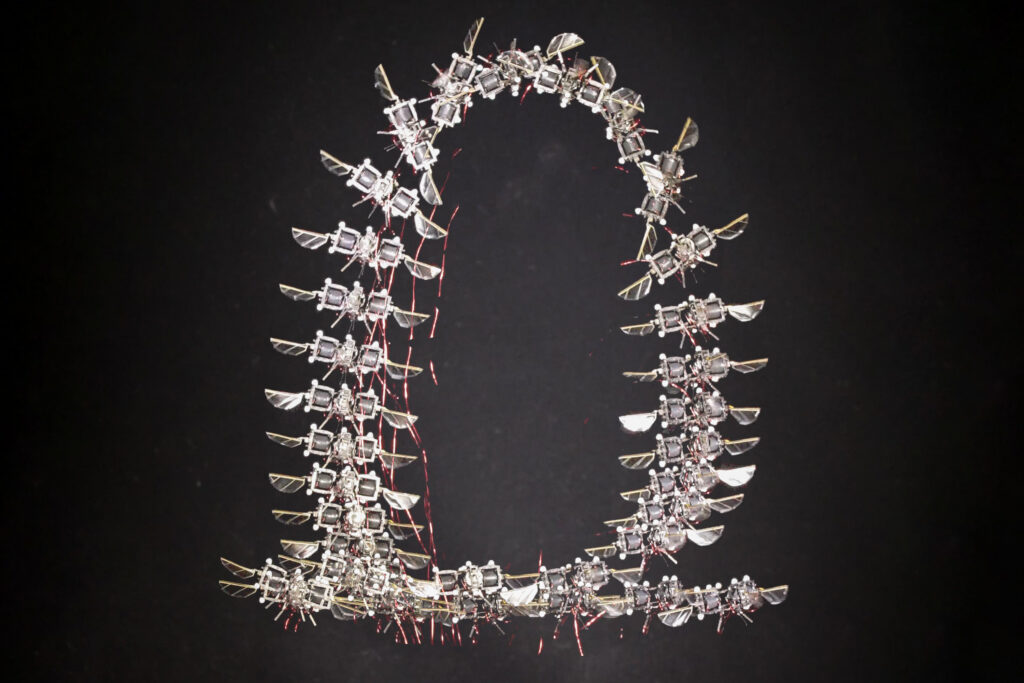
It can also perform some fairly impressive aerial gymnastics. The robot completed 10 consecutive somersaults in 11 seconds, while staying within 4-5cm of its intended flight path, even when faced with wind disturbances.
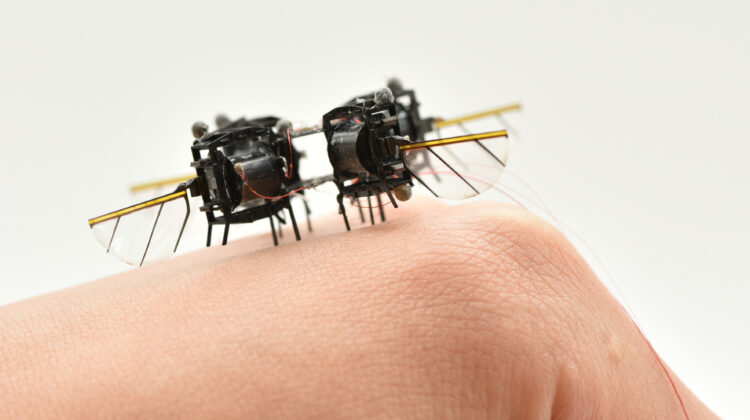
The microrobot itself is around the size of a microcassette and weighs less than a paperclip. Rather than using the rotary motors found on conventional quadcopters, it flies using larger flapping wings powered by soft artificial muscles, which move the wings at extremely high frequency.
Advertisement

MIT researchers have been developing these robotic insects for more than five years, gradually improving the hardware. But as the robot became more capable, its hand-tuned controller increasingly became the limiting factor.
Flying like an insect requires a control system capable of dealing with aerodynamic uncertainty while making decisions quickly enough for aggressive manoeuvres. To tackle this, researchers developed a two-stage approach combining model-predictive control with deep learning.
First, a mathematical model predicts how the robot will behave and calculates the actions needed to follow a particular trajectory. This allows the system to plan demanding movements such as flips, rapid turns and steep body tilts while taking into account the forces and torques the tiny robot can actually produce.
That process is too computationally intensive to run directly in real time, however. Instead, the researchers used it to train a deep-learning ‘policy’ through imitation learning. In effect, the AI learns from the more powerful controller and reproduces its behaviour in a form that can make flight decisions much faster.

‘The robust training method is the secret sauce of this technique,’ said Jonathan How, Ford Professor of Engineering at MIT and co-senior author of the research.
Advertisement
The robot also demonstrated a movement known as a saccade, where insects rapidly accelerate towards a position before pitching in the opposite direction to stop. Such behaviour could become particularly useful once cameras and other sensors are fitted to the robots.
‘We want to be able to use these robots in scenarios that more traditional quadcopter robots would have trouble flying into, but that insects could navigate,’ said Kevin Chen, associate professor of electrical engineering and computer science at MIT.
There is still work to do before swarms of robotic insects are searching earthquake rubble. The current system relies on an external computer and motion-capture equipment, so the next challenge is to bring sensing and navigation onboard.
Researchers also want to explore how multiple robots could avoid colliding with one another and coordinate their movements – potentially allowing whole swarms of tiny flying machines to navigate complex environments together.