
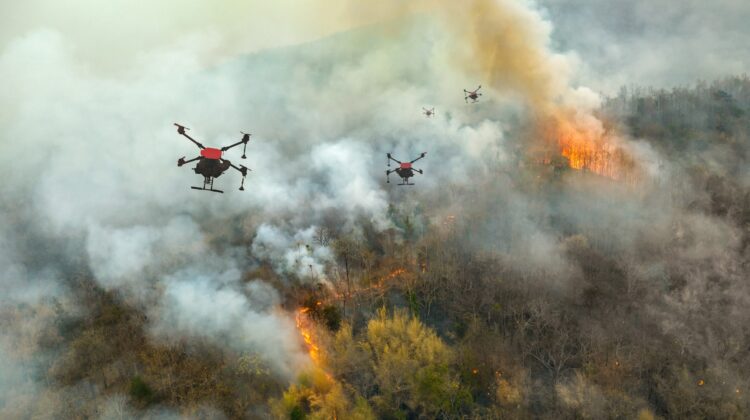
An autonomous drone system designed to detect and respond to wildfires within minutes has secured a US$500,000 award in the international XPRIZE Wildfire competition.
Developed by AURA Foresight, an international collaboration co-led by robotics researchers at the University of Bristol, the platform combines artificial intelligence, optical and thermal sensing and autonomous aerial vehicles to identify potential fires and coordinate a rapid response.
Rather than waiting for a reported fire to trigger deployment, the system is designed to continuously monitor large areas. AI analyses sensor data for signs of a possible ignition, before autonomous drones are dispatched to verify the detection and provide information that can support intervention while the fire remains small.
The technology was demonstrated during the final XPRIZE Wildfire challenge in Alaska in June, where AURA Foresight competed against two other finalists selected from more than 130 teams worldwide.
Advertisement

Operating across a 270-square-mile (700km²) wilderness area, the system was required to detect and verify potential wildfire ignitions and coordinate a response. AURA Foresight successfully deployed a fully autonomous drone swarm to respond to potential fires within 10 minutes.
The performance earned the team third place in the competition’s Autonomous Wildfire Response track and a US$500,000 prize. The results were announced at the New York City Fire Museum on 23 September.
Launched in 2023, the US$11m XPRIZE Wildfire competition was established to accelerate the development of technologies capable of improving wildfire detection and response.
AURA Foresight combines the UK-based AURA project, led by the University of Bristol, with Australia’s Fire Foresight. The University of Sheffield developed the thermal and electro-optical vision detection technology used by the UAV swarm.
The engineering challenge extends beyond getting multiple aircraft into the air. The platform integrates persistent sensing, automated detection, autonomous flight and verification into a system designed to operate over large and potentially remote areas.
Advertisement
Researchers have developed the technology alongside firefighters and emergency-response specialists, including Lancashire Fire and Rescue Service and wildfire experts in Australia and Canada, with the aim of ensuring it can integrate with existing emergency-response operations.
‘This award is a fantastic recognition of years of collaboration between researchers, firefighters and technology specialists working towards a worldwide challenge: preventing small ignitions from becoming devastating wildfires,’ said Professor Sabine Hauert, AURA Foresight co-lead and Professor of Swarm Engineering at the University of Bristol.
The team has also focused on making the platform practical to deploy. It is built around commercially available technologies, requires minimal setup and is designed to be adapted to environments ranging from remote forests to critical infrastructure corridors.
Dr Georgios Tzoumas, AURA Foresight co-lead and Senior Research Associate at Bristol, said the ambition was to deliver ‘practical, affordable tools’ that help emergency services detect and contain wildfires before they develop into major disasters.
By combining autonomous sensing, AI and aerial robotics in a single platform, the project demonstrates how engineered systems could reduce the time between the first indication of a wildfire and an effective response.