
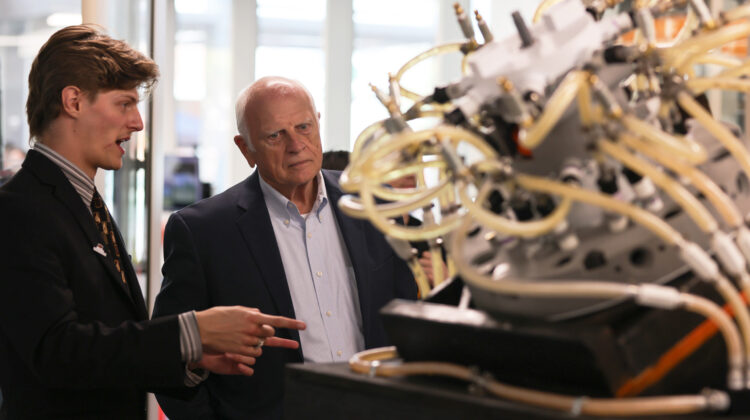
A team of students in Oklahoma State University’s College of Engineering, Architecture and Technology, in collaboration with AmeriBand, a company based in Fort Worth, Texas, have built a prototype of an innovative engine design dubbed the AspireCVD.
Mechanical engineering technology seniors Jack Chartier (pictured above, at left), Ian Gresley, Jayden Wall and Dax Yosten, and mechanical engineering seniors Austin Landrum and Jacob Schindall worked with AmeriBand on aspects of the engine.
The small but powerful engine is fuelled by 87-octane petrol, but can potentially reduce hazardous emissions due to its fuel efficiency. AmeriBand claims the engine’s design can improve fuel efficiency by 60 per cent.
‘There’s a mechanism in the bottom that can change the length of stroke for the pistons, which is how you get that change in displacement for this engine,’ Chartier said. ‘The goal is for it to be completely dependent on the driver pressing the pedal for how much power is supplied.’
Advertisement

An innovation of the engine is its wobble plate, which supplies continuously variable displacement on a cylinder and valve deactivation piston engine. While wobble plates are common in hydraulic pumps, using one in an engine is an innovative design. The piston displacement is changed by altering the angle of the wobble plate.
With the engine’s entire range of performance being controllable, fuel consumption can be optimised. It uses a low amount of fuel when idling, one of the primary ways in which it increases efficiency.
The engine has a range of 3.65–11 litres – similar to the range from a V6 engine to a semi-truck engine – depending on its utilisation. The CEAT students helped primarily with the valve and cylinder system as their senior design project.
AmeriBand has touted the engine’s fuel efficiency and capabilities but lacked a physical prototype. The students’ engineering design work has helped to reaffirm the claims, as well as developing a prototype for their senior design project. The engine was also tested on a bench stand.
This engine’s complexity led to a lot of initial questions and presented a challenge from which the students benefited. ‘It’s worked our brains,’ Chartier said. ‘Vaguely understanding how engines work and then introducing this changed everything you know about how an engine works. I speak for myself, but also for the rest of the team – I had not seen anything like this before. There’s a reason why it would be some brand-new thing on the market. I’ve seen something similar in a plane engine, but this is something our client wants to put out on the road.’

Advertisement
The students enjoyed having regular communication with AmeriBand and trying to meet the company’s design specifications. They were pleased with the level of creative freedom as well as getting positive feedback during bi-weekly meetings.
‘Another nice part of it has been the communication with the client,’ Chartier said. ‘He had some implications for the engine, and it was nice to see the client relationship because we will see that when we work in the industry.’
Mike Pastusek (pictured above, at right), co-inventor of the AspireCVD, said he has been pleased throughout the collaboration with CEAT students. ‘The model that OSU built for us was really nice as a 3D-printed model,’ Pastusek said. ‘It worked really well, and the concept proved itself out on its ability to vary timing. The entire system was built well. It fit the concept we were looking for very well.’
He said the success of the student team shows the importance of OSU’s engineering students gaining direct experience, which will benefit them when they enter the workforce. ‘I think that is something that the programme at OSU is doing, which is fabulous, because you get to put your hands on something and it makes it not theoretical anymore,’ Pastusek said. ‘I think some of the students may have been new to this when they started, so I think they learned a lot from the process of trying new things and things that don’t work. I believe you learn more from some of your mistakes you make while trying new things.’
The students surpassed the goals they faced by producing a functional prototype. This advanced the research past computer simulations into tangible proof of the engine’s range of capabilities. ‘Having him come out to see the actual model was nice because pictures only do so much,’ Chartier said. ‘You can pick it up and see all the design aspects of it and he was very pleased.’