
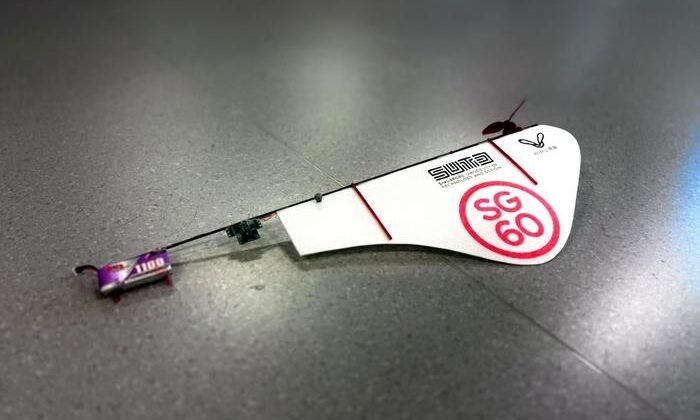
An engineer from Singapore University of Technology and Design (SUTD) has developed an innovative nature-inspired drone design that redefines how efficient small flying robots can be.
When Singapore celebrated its 50th year of independence in 2015, a team of student researchers led by associate professor Foong Shaohui embarked on an ambitious challenge: to design and build a drone capable of 50 minutes of sustained flight. At the time, most hobbyist quadcopters could barely manage half of that. The SG50 Multi-Rotor Drone project succeeded, but to fly that long, the craft had to be large, complex and heavy.
A decade on, Foong has reached new heights in his drone research – this time by going small and pursuing a completely different strategy. Rather than trying to improve the efficiency of the multi-rotor drone, which is inherently inefficient by design, he turned to nature and developed a lightweight monocopter inspired by samaras – spinning maple seeds that spiral gently to the ground. The new ‘copter achieves efficient and fully controllable flight with only a single actuator.
Foong’s design embraces autorotation and leverages aerodynamic efficiency over brute-force thrust. The minimalist yet highly efficient monocopter weighs just 32 grams and can hover with full automatic control for 26 minutes, far surpassing typical drones in its class.
Advertisement

According to Foong, the drone is part of a broader effort to turn the design of flying robots on its head by doing more with less. His new design broke new ground for rotorcraft in this weight class.
‘Achieving flight becomes increasingly inefficient as you scale down,’ he said. ‘Small drones often have poor endurance because their small propellers generate limited thrust and yet still draw significant power. Our goal was to overcome that constraint.’
The solution, as it turns out, was to look to nature. Samaras offer a compelling aerodynamic mode, combining passive stability with efficient lift generation in a beautifully simple form. ‘Every part of a maple seed contributes to lift. We took inspiration from that principle and built an airframe where nothing is wasted,’ Foong explained.
The strategy of using samara seeds as inspiration stemmed from a human-centred observation – something AI probably wouldn’t have identified on its own. The improved wing design was then achieved through AI-powered optimisation, which enabled the team to efficiently explore design possibilities without exhaustively testing every configuration.
In contrast to conventional quadcopters, which control multiple rotors, the team’s monocopter achieves flight with just one actuator. This single motor drives a winged body into a spin, stabilising it through passive dynamics while providing lift through a large airfoil. Without flapping parts, gearboxes or mechanical linkages, the design is structurally simple and yet mechanically efficient.
Advertisement
‘Efficiency usually improves with an increase in scale. Here, we’ve reversed that. We’ve managed to shrink the system while making it perform more efficiently,’ said Foong.
Behind the monocopter’s success is an extensive design optimisation process that combines classical aerodynamic theory with real-world performance modelling. The SUTD researchers used a surrogate optimisation method, a kind of data-driven search algorithm, to fine-tune the wing shape, pitching angle and mass distribution. The resulting drone hovers with a power loading of 9.1 grams per watt, outperforming other hovering-capable micro air vehicles of comparable size and weight.
‘It’s a first-of-its-kind achievement,’ said research fellow Cai Xinyu. ‘We’ve demonstrated that with the right aerodynamic and system-level design, a tiny aerial robot can achieve endurance that rivals much larger systems. This shows that size no longer needs to be a limiting factor.’
The monocopter’s endurance and simplicity are a boon for low-cost, long-duration missions. Among the applications being explored is a lightweight, reusable radiosonde, a balloon-borne instrument for weather sensing and monitoring, which was the Sustainability Winner at the James Dyson Award 2024.
While the current prototype uses commercially available components, future work will look into developing bespoke parts to push performance further.
‘The next step is to increase payload capacity and flight time without significantly increasing weight,’ said Xinyu. ‘We’re also looking to explore advanced materials.’
The monocopter project is a perfect example of how rigorous engineering and thoughtful design thinking can turn a nature-inspired idea into a viable technology platform. ‘It’s about understanding the underlying physics, modelling it faithfully, and using that knowledge to push the limits of what small aerial robots can do,’ said Foong.
The research has been published in IEEE Robotics and Automation Letters.