
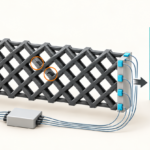
A crack can begin deep inside a component, out of sight long before the damage becomes obvious. Now, engineers at the universities of Glasgow and Sydney have borrowed a medical imaging technique to watch cracks develop inside 3D-printed materials, potentially giving future components a way to warn of approaching failure. The team printed plastic containing carbon nanotubes … [Read more...] about 3D-printed materials reveal damage before they fail
Waste eggshells used to strengthen magnesium alloys

Discarded eggshells could provide a useful ingredient for manufacturing lightweight metal components. Researchers at North Carolina State University have demonstrated a technique that uses finely ground shells to produce stronger, harder magnesium alloys, replacing calcium materials normally manufactured from mined ore. Magnesium alloys combine low weight with mechanical … [Read more...] about Waste eggshells used to strengthen magnesium alloys
King’s launches ‘self-driving’ laboratory initiative

Laboratories capable of running experiments, analysing the results and deciding what to test next are the focus of a new £150,000 initiative at King’s College London. King’s Autonomous Labs (KAL) will bring together artificial intelligence, robotics, sensors and laboratory automation to explore the development of so-called ‘self-driving’ laboratories. Rather than simply … [Read more...] about King’s launches ‘self-driving’ laboratory initiative
Could the soil beneath our feet behave like a computer?

Soil might look fairly inert, but beneath the surface it is constantly responding to water, temperature, nutrients and biological activity. Now Cambridge researchers are exploring a more unusual possibility: that soil itself could be treated as a kind of natural computer. Researchers at the University of Cambridge’s Bio-Inspired Robotics Laboratory are investigating soil as … [Read more...] about Could the soil beneath our feet behave like a computer?
AI gives insect-sized flying robots a 450 per cent speed boost

Tiny flying robots that can flip, dart and change direction like insects could one day be sent into places too dangerous or confined for conventional drones, from collapsed buildings to other hard-to-reach environments. Researchers at MIT have taken a step towards that goal with an AI-based control system that gives an insect-scale flying robot far greater speed and agility. … [Read more...] about AI gives insect-sized flying robots a 450 per cent speed boost